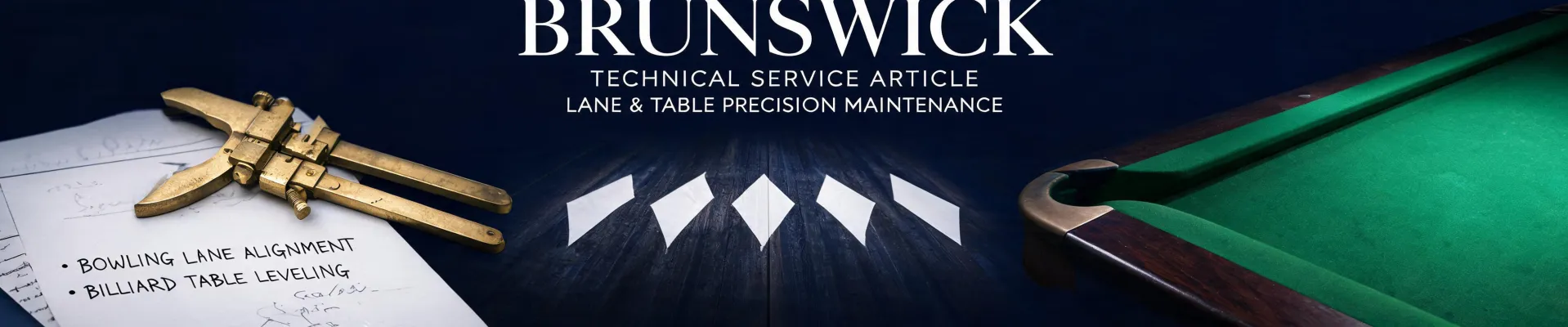
I've spent seven years as the procurement manager for a regional family entertainment group. I've reviewed upward of $1.8 million in purchase orders, replaced more slate seams than I want to admit, and built a maintenance spreadsheet that my team probably knows better than their own schedule.
So let me state my opinion clearly: If you're buying commercial bowling or game room equipment without a preventive maintenance plan, you're not buying value. You're betting against your own future repair costs. In my experience, that bet usually fails.
This isn't a blind 'buy Brunswick' argument. It's a total cost of ownership argument. The brand matters because of duty cycles, parts availability, and service networks. But the maintenance plan matters just as much.
The mistake that taught me to do the math
In my first year, I made the classic specification error: I assumed the word 'commercial' meant the same thing to every vendor.
We bought a pool table that was $2,100 cheaper than the equivalent Brunswick table. On paper, it was commercial-grade. In reality, the slate seam tolerance was bad and the leveling system couldn't hold. Within 14 months, we had two leveling calls at roughly $240 each, a complaint log I didn't want to print, and a table that played like a highway under construction. I want to say it cost us another $600 in lost game revenue, but don't quote me on that exact number.
We replaced it with a Brunswick table. That was in 2019. Aside from routine cloth changes and cushion work, it's still running today. Put another way: the cheap table was $2,100 less at the beginning, and it cost more by the second year. The Brunswick table didn't save money upfront. It saved money by not becoming a project.
Three reasons I still build maintenance into every Brunswick purchase
After that first mistake, I started comparing equipment with a maintenance check built into the spreadsheet. Here's what I look at now.
1. Downtime is a revenue problem, not a repair problem. When a parent searches for 'urban air trampoline park near me,' they aren't thinking about trampoline springs. They're thinking about whether the birthday party will actually happen. Your bowling center is in the same category. If two lanes are down on a Saturday, you're not just losing lane rental. You're losing party bookings, shoe rental, food service, and the complaining online review that shows up on Monday.
2. Specifications matter more than the name on the sign. I read a Brunswick spec sheet differently than I read a generic one. I want to know the duty cycle, the service intervals, the part number count, and how easy it is to get a replacement circuit board. Brunswick bowling brands also have a long enough track record that you can look at a model from three years ago and see how it held up. That's the kind of information procurement people need, but it's rarely in a sales brochure.
The same logic applies to bowling balls. A Brunswick Hypnotize bowling ball is a reactive resin ball that gives a league bowler a predictable hook. When someone asks 'how to curve a bowling ball,' the answer starts with hand position, but it also starts with a ball that actually hooks when you release it properly. If your inventory is all worn house balls, that advice won't help.
3. Preventive maintenance is the cheapest insurance you'll buy. I built a 12-point checklist after getting burned on that first table. It costs about twenty minutes per table and forty-five minutes per pinsetter. Since 2023, we've had zero lane-down events during open hours, and I attribute that to the checklist, not luck. Five minutes of verification beats five days of correction.
What the 'we can fix anything' argument gets wrong
I have mixed feelings about relying on a talented local technician. On one hand, I've met mechanics who can fix almost anything. On the other, emergency repair calls are expensive, unpredictable, and often happen at 6pm on a Friday. The problem isn't the technician. The problem is that you only discover a problem exists after revenue has already stopped.
The same logic applies beyond bowling. A fitness floor with Nautilus gym equipment can generate steady revenue, but if a cable snaps on a machine at peak time, you're not just paying for a cable. You're dealing with a safety incident, a disabled station, and a member who decides the gym across town is more reliable.
That's why I don't buy blanket maintenance plans. Instead, I line-item them: pinsetters get quarterly checks, tables get cloth and cushion timelines, balls get surface maintenance, and the fitness floor gets a weekly cable inspection. I know that sounds like a lot. But it's less expensive than the alternative. In Q2 2024, a controller board on one of our Brunswick pinsetters failed during league night. Because we were already on the service schedule, the replacement was approved and installed within three days. If we hadn't been on that schedule, we would have been waiting a week and explaining league rescheduling.
You might argue that the upfront price difference matters when you're opening a new location. I get it. I've stared at the budget line myself. But between hidden setup fees, shipping costs, and the first emergency repair, the 'cheap' option usually ends up in the same price neighborhood. The difference is that the Brunswick option comes with a predictable service history. (Should mention: we still use a non-Brunswick table in our staff breakroom. That's fine. It gets maybe six hours of use a week. Duty cycle is the point.)
So, would I buy Brunswick again?
Yes, but not because of the logo. I'd buy it because the total cost of ownership is easier to forecast, the parts are available, and the maintenance plan keeps problems from becoming emergencies. Brunswick has been making this kind of commercial equipment for more than 170 years. That's not nostalgia. It's a supply chain advantage that shows up when you need a part.
If you're setting up a commercial space, don't ask yourself which equipment is cheapest on the first invoice. Ask yourself which equipment you can still afford to run in year three. Plan the check, do the check, and budget for it. Prevention over cure, every time.
Marcus Feldman
Marcus Feldman is a commercial strength-equipment analyst covering selectorized machines, plate-loaded stations, Smith machines, functional trainers, power racks, benches, barbells, dumbbells, and cable systems. He applies ISO 20957-1 and ISO 20957-2 while comparing rated loads, stability, frame deflection, pulley ratios, cable travel, adjustment increments, guarding, entrapment points, fastener retention, and fatigue cycles. His guides help gym operators, coaches, facility planners, and procurement teams evaluate biomechanics, user capacity, floor layout, maintenance access, durability, and lifecycle value.