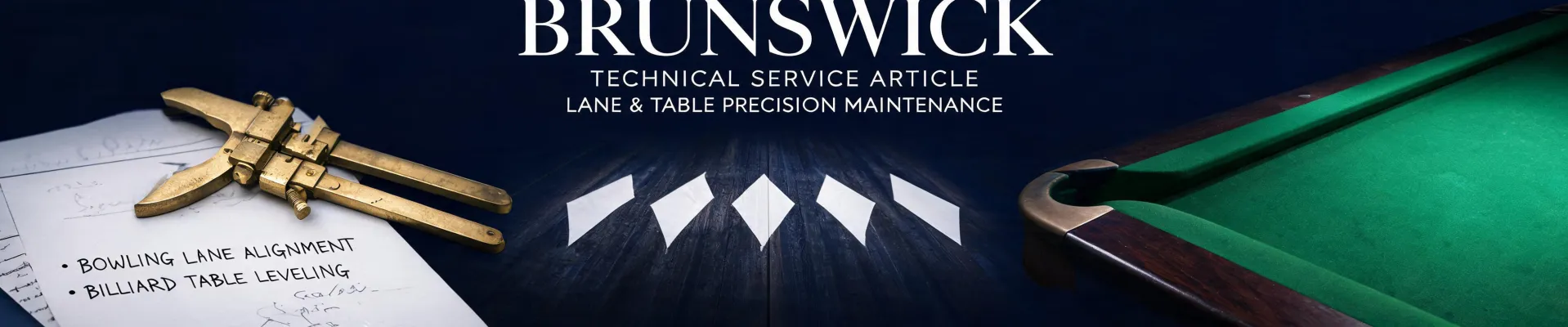
The Problem Isn’t Just the Price Tag
If you’ve ever been handed a quote for a Brunswick 7 foot pool table set-up, or a full string of bowling pinsetters, you probably did the same thing I did: you winced, checked your budget, and started hunting for a deal. I get it. For a rec center or a family entertainment zone, the initial outlay on a list of Brunswick pool table models can feel like a lot. It’s easy to think the problem is the invoice.
Take it from someone who’s coordinated the installation of over 40 commercial gaming tables in the last three years alone. The price is not the problem. The problem is what happens after you buy. I’ve seen new venues open with gleaming air hockey tables and Horizon Fitness T101 treadmills, only to have a $500 machine failure shut down their busiest Saturday. The problem isn't the purchase—it's the downtime.
The Real Cost: The Silence of a Broken Machine
That’s the deep issue no one talks about. For a commercial operator, equipment isn't a capital asset; it's a revenue generator. When a piece of equipment is down, you aren't just losing the rental fee. You’re losing the customer. You’re losing the birthday party. You’re losing the league night.
I remember one client who bought a secondhand pinsetter to save $6,000. (I told them not to. Honestly, I was pretty emphatic.) They wanted to save money on a single piece of gear for their refurbished lanes. It worked for two months. Then it broke during a packed Saturday night event. The part alone cost $800—and it took three days to get a technician out. The lost revenue? An estimated $4,500 in lane rentals and bar sales. That $6,000 'savings' vanished in a single weekend of downtime.
The most frustrating part of this business is that people think they are saving money by cutting corners. You’d think a written specification would prevent these failures, but the hidden cost of cheap equipment isn't the repair bill—it's the broken trust with your paying customers. If someone tries an escape room on a first date (and, for what it’s worth, yes, an escape room is a great first date if you want to see how you solve problems together), and the equipment is faulty, they aren't coming back.
Three Hidden Liabilities You’re Probably Ignoring
Looking back at the dozens of installations I've managed, I've identified three common mistakes. When I'm triaging a rush order for a repair or replacement, these are the root causes 90% of the time. If you can prevent these, you can avoid the emergency calls.
1. The “Good Enough” Foundation.
Commercial equipment, whether it’s a Brunswick 7 foot pool table or a high-end air hockey table, needs a rock-solid base. I’ve seen operators put commercial-grade slate tables on uneven floors. The table rocks, the play is off, and the mechanism wears out unevenly. The fix—shimming or moving the table—costs more than the initial installation because now you have to de-install and re-level. Per FTC guidelines on substantiating claims (ftc.gov/business-guidance/advertising-marketing), if you claim a table is 'professional grade', the installation must support that claim.
2. The Myth of “Set It and Forget It”.
Your Horizon Fitness T101 treadmill isn't a car that you can just fuel up and drive. It’s a mechanical device that requires daily lubrication and belt tension checks. The same goes for a pinsetter. I once had a client call me at 6 PM on a Friday because their league night was canceling. The issue? A $5 belt that had snapped because no one had followed the maintenance schedule. The schedule was in the manual! He admitted he hadn’t looked at it.
3. Buying the Wrong Tool for the Job.
Not all commercial equipment is created equal. There is a vast difference between a home-use air hockey table and a commercial coin-operated one. The blower motor, the scoreboard, the surface durability—all different. I often see a list of Brunswick pool table models and people pick the cheapest, thinking 'it's still Brunswick'. But a home model used in a bar will fail within a year. The cost of that mistake is the entire purchase price, plus installation and removal.
My Checklist: The $8,000 Mistake That Fixed Everything
After the third time bailing out a client who bought the wrong gear, I created a simple 12-point checklist. It’s basically my pre-flight check before any installation. That single checklist—which took me an hour to write—has saved an estimated $8,000 in potential rework and emergency service calls for my clients.
Here are the three most important points from it:
- Spec Check: Is this specific model rated for 8+ hours of daily commercial use? (Check the manufacturer's spec sheet, not the product description.)
- Warranty Support: Who services it? If the unit breaks on a Saturday, can I get a tech out within 12 hours? If the answer is 'we have to ship it back', walk away.
- Total Cost of Ownership: Factor in installation, leveling, electricity, and the cost of a standard maintenance kit for the first year. Add 20% for the 'just in case' fund.
Prevention Over Cure: The Simple Solution
The solution isn't to buy the most expensive item on the list of Brunswick pool table models. It’s to buy the right item and then treat it like the revenue generator it is. The 5 minutes of verification before buying—checking the specs, the floor, and the maintenance plan—beats 5 days of downtime when your customers are waiting.
Bottom line: Equipment is only an asset if it’s working. Don’t gamble your revenue stream on a deal that looks too good to be true. Trust me on this one.
Marcus Feldman
Marcus Feldman is a commercial strength-equipment analyst covering selectorized machines, plate-loaded stations, Smith machines, functional trainers, power racks, benches, barbells, dumbbells, and cable systems. He applies ISO 20957-1 and ISO 20957-2 while comparing rated loads, stability, frame deflection, pulley ratios, cable travel, adjustment increments, guarding, entrapment points, fastener retention, and fatigue cycles. His guides help gym operators, coaches, facility planners, and procurement teams evaluate biomechanics, user capacity, floor layout, maintenance access, durability, and lifecycle value.